Click below to listen to Adam read the essay.
The first day of new student orientation, I felt lost.
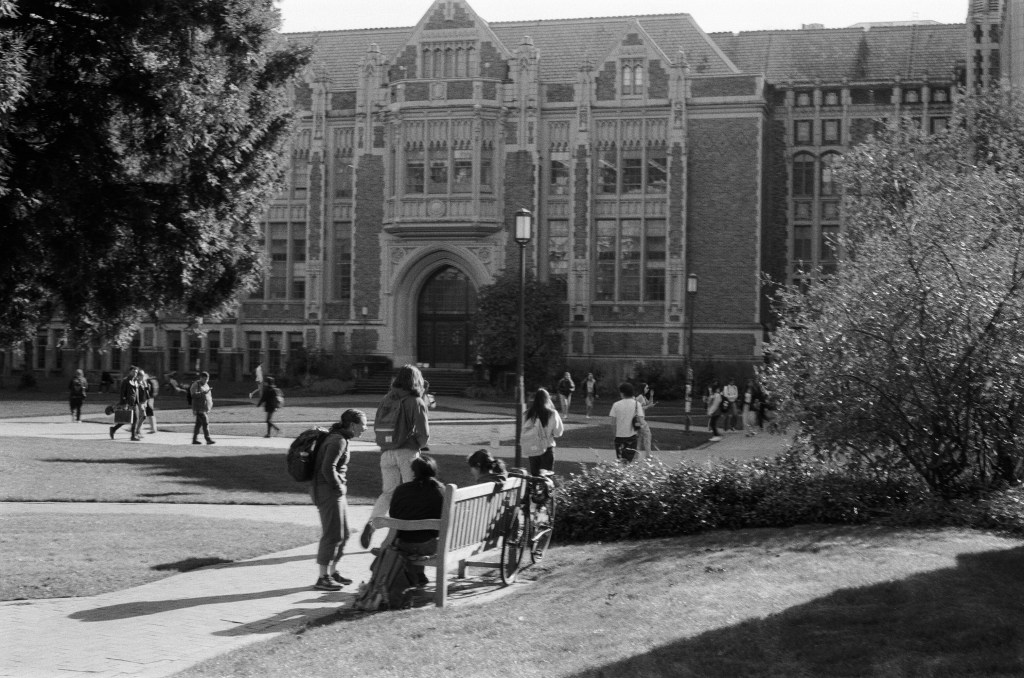
I was in the sparkling new Hans Roslin Center for Population Health at University of Washington. It was a modern building when compared to much of the others on campus and, like most of the health and computer science buildings, it was built within the last ten years using an all-glass façade and exposed concrete columns in the architecture. The north door let into a vaulted and cavernous entry that exhibited the advances of engineering and design since the last new buildings were constructed, complete with a Starbucks.
But I wasn’t thinking about that.
Leading up to this moment, I had spent over a decade of my life as a crane operator providing the labor necessary to build flashy new towers like this one all over King County, buildings I rarely got so much as to walk through when they were finished. What I was thinking about when I entered that orientation, was how it had been fifteen years since I graduated high school, that I still had two years left of undergrad, and I’d never set foot inside a public high school or university as a student before.
Our orientation was pooled by our status as transfer students. It was held in a bright classroom that could seat maybe forty people which was bordered by three white walls except the one made completely of glass that gave a view of the lobby through which I had entered. There were perhaps twenty people in the room, all younger than me by at least a decade except a short Latino man in his early forties who wore a purple UW tee shirt and had thinning black hair. He shook my hand warmly and told me that he was a first-generation student, too, pursuing a nursing degree and he stared blankly back at me when I told him I was an English major.
Besides a budding anthropologist, Jay, who had taken a couple years off since high school to do aerial performance in the circus, the remaining transfer students in that room were largely forgettable except for one thing. We all had the cold sweat smell of inferiority that only community college students can feel when faced with a sprawling and polished institution like University of Washington. I harbored no allusions that I would get the kind of experience that most people I knew had had in college, a chance to make friends that would last them their lifetime afterwards, bonds that can only be forged when people are the same age, facing similar questions, and have a similar understanding of the world. For me, despite the newness of it all, the world had oxidized. For the teenagers in that room, I imagined it still glistened like young copper.
Being an older student with a career behind him had its luxuries though. The people I was in school with weren’t part of my generation, so their approval or camaraderie wasn’t so important to me because our age, experience, and things we favored were different. I didn’t have to face them at the dorms, parties, or around the Ave. Yet, that also meant that college for me would mean something entirely different, but it wasn’t just my age that set me apart.
If you’re just meeting me, you might be wondering why a guy would leave a sturdy career and a six-figure income at the age of thirty to start his bachelor’s degree.
It’s a good question.

As a child, for as long as I could remember, my parents spoke of leaving the suburbs and going to a place with a lot of trees, open space, and fresh air. In the spring of my eleventh year, they made that a reality. We moved near the panhandle of Idaho, twenty minutes outside a town of a thousand people, and to a plot of undeveloped land at the end of a long dirt road that was so narrow in places that the branches of trees thwacked the mirrors and scraped the side panels of our cars. A family of six, we spent the following six years passing the seasons in a travel trailer that leaked, let in bugs and mice. I often was startled awake by the scrape of tiny claws in the furnace ducting or the tickle of ants as they nibbled on my toes.
During those years, and all of the years before, my brothers and I had been homeschooled by textbooks created by the evangelical homeschooling institution, Abeka, out of Pensacola, Florida. Our teacher, my mother, became exhausted with her role by the time we reached the fourth grade, and each year after, she handed us our textbooks, test books, and answer keys, told us that we were smart, that we were the smartest boys, and that we were ready to learn on our own. I swelled with pride when she told me this. I did not question things. I believed they knew what was best for me, that my education and our journey to the wilderness was a holy one. After all, a big part of the reason we moved was because they believed Portland, in whose southeastern suburbs we had been nestled, was turning into Gomorrah, the city in the Old Testament of the Bible that God destroys by fire because of its wickedness. They believed that God was calling us out, and we had been instructed to leave and never turn back.
My mother often spoke of prophecy, as did our favorite pastor and TV evangelist, Kenneth Copeland, and one of her most profound and reoccurring prophecy was that she would one day have a log home somewhere in the country that was big enough for the grandkids that her four sons would bring her. It would take the rest of my childhood for that prophecy to come true and it was mostly made possible by the labor of my brothers, father, and me. By the time I was fourteen, I was out in the woods alone with a chainsaw, felling the oldest and strongest of our evergreens to become the walls of that home. I was seventeen when we moved out of the cramped space of that travel trailer into the unfinished house that smelled strongly of sawdust and flooring glue. It was then that I began to wonder at the nature of prophecy.
At eighteen, like many people in America, I graduated high school, but unlike many I was the only person in my graduating class and was presented with a diploma my parents had printed at the Office Max, over an hour drive away in Spokane, because they had the special paper for it. My mother wrote my name in the middle and signed the bottom in delicate calligraphy. What I didn’t know then was, because of their anti-government stance, my parents had not followed the rules to have my degree state certified. It was essentially worthless. My brother had to take the GED to join the U.S. Marines. For me, I didn’t know anything about college, but I wanted to go. Since I missed grade school, middle school, and high school, I wanted at least one shared experience in my teens that could make my life relatable to people I met. However, I had no idea how to get to college or what I would do when I got there, the process of all those forms and tests, how by the time I was eighteen I was already years behind, and there wasn’t any money to pay for it anyways.
I had friend who recently told me that there are parts of my story that he can empathize with and others that are just so different that he has a hard time understanding, that it makes him drift off because it’s so foreign. He suggested that it might be helpful to have something like a bubble map powered by AI that could translate my stories and show him what experiences he has that are connected by emotion, if not circumstance, to my own. He was trying to help in the way he knew how. But my throat was tight for the following day. I was still new to this whole process of telling about where I came from, and I’d forgotten that telling a thing doesn’t make it matter to anyone else but you. Sometimes I think I am crazy. That perhaps I see a world that no one else can, that this is not a strength.
When I was twenty, I became one of the lucky few that are able escape the whirlpool of drugs and alcohol that permeate small towns in America, towns of shuttered lumber mills and dwindling options for employment, friendship, or romance and moved west for the promise of opportunity and a better life in the burgeoning economy of Seattle. But I never forgot about my education and quietly held onto the promise I made myself. One day I would get my college education.
I didn’t think it would be ten years later, just before I turned thirty, that I would begin.
My life has crossed many places. I had blue collar parents, both of whom served in the military, and were the last generation who could buy a decent house in the suburbs of the American West with a job title like mechanic. Then after years of searching they found a piece of land that cost about the same as a new truck, just over thirty thousand dollars, and moved there. At that point our lives we entered a sliver of the rural working class who are able to purchase land but are too broke to build on it without financing the materials by taking out a retirement fund fifteen years early and bridging the rest with loans while employing the majority of the labor from their own children. Because I had an incredible amount of energy, and I romanticized the idea that building our home would fix all the ways my family had fractured since we moved, I worked harder than any of my brothers. I often worked on my own, went into the forest, felled and hauled the logs my mother had marked with bold spray-painted X’s, removed their skins, and let them dry in the sun. My jobs afterwards had been as a grocery clerk, a carpenter’s helper, and a shift manager at a fast-food restaurant. Then, a fortunate acquaintance led me to Seattle and a good union job building the infrastructure necessary for a growing urban center. Bridges, tunnels, and skyrises. I left work every day dirty, bruised, and tired. Most of my coworkers had similar stories, at least the small-town rural part. Some hailed from the suburbs but almost no one from the city. Many were veterans or ex-convicts or both. A significant portion my coworkers were either first generation immigrants or perhaps seasonal workers who ached to return home to their families in Mexico. Many of them were happy to have made it here, to the pinnacle of labor in the U.S. under union protection where it’s possible to earn a respectable wage, even lucrative if there was enough overtime, have insurance, and perhaps one day be able to buy a home that was (hopefully) no more than a two-hour drive from the city that you sweated your life out to build.

I always thought that was among the greatest of indignities in our labor. Despite the pride of erecting architectural wonders around Seattle, most of us would never use or enjoy these buildings, subways, or highways. Even though we built it, we didn’t make enough money to make the city our home. Part of this was purely economic but the other part was that most of the people I worked with were conscious of the divide between themselves and the people who walked around the city. How urbanites carried themselves as naturally as if they owned the world, as if they knew everything except what it was like to sweat for work, and we preferred to congregate further from the city with people who knew what it was like to be us.
Yet, I moved to the city anyways.
To this day, I’m often the only person in a room that has worked with their hands for a wage, and it always takes some mental gymnastics when friends and acquaintances talk about their compensation packages, vacation time, and remote work. I listen to their complaints about things I’ve never had the opportunity to complain about. I look at their soft, dexterous fingers and feel a an ache under my ribcage. I am dazzled by their tales of recent vacations to far flung places with friends they met in college, how they’ve gotten their jobs through the connections they made in a fraternity or sorority, and the annoying procedural speed bumps they hit while closing on homes that I could never afford. This is not to paint them in a bad light, they are doing no more than I would do if I had the same opportunities or pathway as them, and there is much more that connects us than divides us, but it is hard for me not to feel a sort of invisibility or unknowability in those moments.
Of all the gene pools, class seems to be one that not only trends toward homogeneity but perhaps naturally selects against hybrids, too, especially those who come from lower economic standing. I doubt it is always a conscious decision but that doesn’t make it any less real.
A couple years ago when I left full time work to attend to my college studies, after two grueling years of taking online classes at a community college while working sixty hours a week building a triple office tower campus in Bellevue for Amazon and all those employees who will dread going into the office. When I finally quit, my boss asked me a question.
“You think your better than us, don’t you?”
I was expecting this. There wasn’t anyone I worked with who entertained the idea of getting their college education. Most of my coworkers had families already and were sole breadwinners or at least played too big a role in their family’s economic well-being to think about doing something as irrational as me. I was in a position that was as foreign to them as being a father and starting a family was to me. Yet, despite my differences, whether it was where I chose to live or that I was undertaking my undergraduate degree—a degree in the humanities no less—I saw more of myself in my boss than in anyone I’ve met in the city.
“No,” I told him. “This is just something I promised myself I would do one day.”
“I don’t know why you don’t just stay up in that crane. If I had your skill, I would never leave the seat. You’re one of the best crane operators I’ve ever worked with,” he replied without listening.
“Maybe I’ll be back one day. Who knows,” I offered.
“Well, good luck with all that.”
I felt like a deserter, still do sometimes, but I don’t believe I’m any better than anyone I worked with. I simply have different questions I want to ask the world and rather than buy a home in Black Diamond or Arlington and spend the next thirty years commuting three to four hours a day to Seattle, I wanted to see if there was a different way we could live.
And I guess that’s a little of what it’s like to be a thirty-four year old undergrad.

 Sunday Coffee by Adam Ramer
Leave a reply to Sean Reed Cancel reply