A Reflection on Homeschooling, the Conservative Christian Right, and Tara Westover’s ‘Educated’
“O my body, make of me always a man who questions!” – Frantz Fanon, Black Skin, White Masks
At the end of a tumultuous first semester at BYU, Tara Westover inscribed these words in her diary: “I don’t understand why I wasn’t allowed to get a decent education as a child” (Westover 163). That line came from Westover’s memoir, Educated, published in 2018,whichfocuses on her life in a Mormon fundamentalist, homeschooling, anti-government, and anti-medical establishment family and her heroic educational journey that culminates in a PhD from Cambridge. In January 2020, I was visiting my parents’ house in northeastern Washington State, and I listened to the audiobook while chopping firewood, not giving the book much thought. I had no idea it would change my life. When I heard that line, that question with a period at the end, something snapped in me. I stopped working, dropped the ten-pound splitting maul on the floor, and walked out of the shed. Out in the open, I stared at the meadow and distant trees, all covered in a heavy blanket of snow. Westover’s childhood and mine were very similar. However, I never went to college, despite a promise I had made to myself at eighteen that I would one day.
I paused the audiobook.
The world around me was so quiet; there wasn’t the continual thrum of traffic or airplanes that I had grown used to in Seattle. Not even the dogs barked. It was as if this place was detached from the world. I could hear my ears ring.
Why wasn’t I allowed to get a decent education as a child?
I looked around. Rows of raised gardening beds, now dormant, were long rectangular lumps under the snow. Next to the beds was the tractor and little trailer attached behind, which I had hauled rounds of logs up to the shed earlier in the day. Then I turned my eyes toward the hill and the log cabin, whose chrome chimneys sent up wreaths of smoke.
I believed I knew the answer to that question.
Like the Westovers, my parents were driven by a similar idealism, which urged them in 2001 to flee the suburban liberalism of western Oregon for a place more welcoming or perhaps simply more private and thus more agreeable to their beliefs and religious zeal. I was eleven when we left for what my mother called the Promised Land. Not like the one in the Bible but the one God promised her in a vision years before. Such claims were considered wholly rational and a sound basis for making decisions in my family. This sort of magical thinking might have given me pause if there had been any dissenters in our lives, but, like many people, my parents only stayed in touch with people they agreed with. The only time my world extended beyond family was when we went to church, a place that only confirmed my parents’ source of wisdom.
We never went to the doctor; instead, we used herbal medicines, banned sugar, and made loaves of bread with fresh ground wheat flour from the sacks of grain we kept in the hallway. Reagan was the greatest president that ever lived, according to my father. Both of my parents were veterans and owned multiple guns, but we never had anything that looked like an assault rifle. They believed the rapture was imminent and seemed almost disappointed when Y2K passed without Jesus’ return. They locked the doors on Halloween and told us to stay away from the windows. The list goes on, but you get the picture: they were anxious people with beliefs that made them even more anxious. When it came to education, they believed they were giving us the best education possible through homeschooling.
When I listened to Educated in 2020, I was twenty-nine, and it had been eleven years since I had left home. I saw through my parents’ claim of a better education, a claim that they still strongly defended. However, academically, my education was deemed invalid in the eyes of the state because we neither adhered to annual testing requirements nor met the school district standards. While we celebrated my completion of the twelfth grade with a dinner at Olive Garden, no one but my parents considered the diploma Mom printed out at Office Max, on card stock, and written in beautiful calligraphy, to signify much more than a creative delusion. At the time, I knew that the reason for my education had more to do with limitations than with opportunities. In the years after, I believed I had transcended those limitations. Yet, listening to Tara Westover’s story made me realize that some of me had never healed—my parents’ decision to homeschool me was one of the most consequential events of my life.
I thought I knew why I didn’t receive a decent education.
It would be generous to call what we did school if this is to mean an equal substitute for the rituals and intellectual stimulation of public schools. Then again, I never went to public school. In the early days, we began with the Pledge of Allegiance out on the front porch of our suburban home before unfolding a table and chairs in the living room to sound out our vowels. After a few years of this, once each of us successfully learned how to read and spell, my mother announced that we were ready to learn on our own. My two older brothers had already moved on to study on their own by the time Mother told me I was prepared to study alone. At those words, I felt the same pride as when my father removed the training wheels from my bicycle. When I was eleven, and we moved to the Promised Land, which was only trees and a muddy access road when we arrived, our studies became especially decentralized. We could do school anywhere and often preferred to take our books outside to sit under the shade of the evergreens. Long gone were formal mornings. Just four boys with their textbooks, each one wise enough to do school however they saw fit.
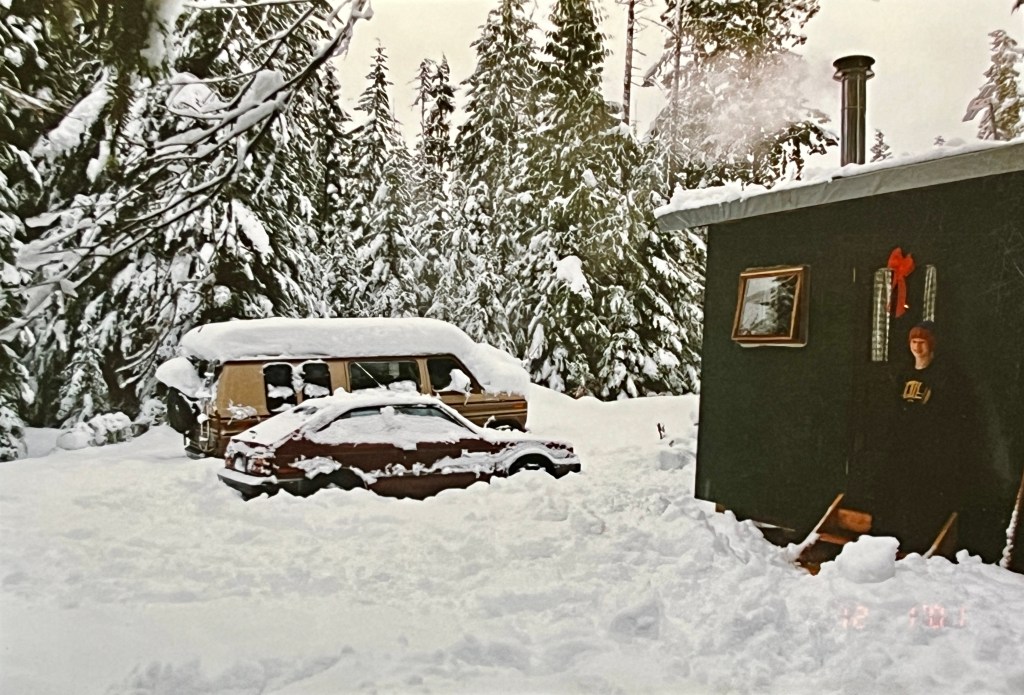
Our property, or the Homestead as we began to call it, lay twenty minutes outside a relatively remote town an hour north of Spokane where my parents, three brothers, a dog, a cat, and I lived in a fifth-wheel travel trailer with a shed propped against it for a living room. This, and the twenty acres of forest, became home when I was eleven. For the next six years, we lived through frigid winters and blazing summers inside a space where we were always in audible or visual contact with one another unless we used the bathroom or went outside. To my parents, perhaps, six years was not such a long time, but to myself, as I went through puberty and grew into my late teens, those six years felt like an eternity. Much of the time, we left the property once a week for church on Sunday. We often stayed home for weeks in the winter when the snow blocked the road to the highway. Our move had been framed as an adventure and certainly lived up to the marketed description. There was excitement in that new environment. Yet, as weather, space, and the remoteness of our land pressed down around us, my world became very small.
Though I had been homeschooled since 1996, when I was six, it was only when we left the suburbs that I began to think of homeschooling as synonymous with isolation. Before then, I was too young to notice and well-satiated with the everyday companionship of my brothers and cousins, whom I saw almost every Sunday at birthdays and holidays. On the Homestead, we were an eight-hour drive from our nearest family in western Oregon. We lacked funds for the drive, as did my family in Oregon, so we rarely saw each other. After the move, I did not see family more than three times before I left home. Due to the Homestead’s location and lack of autonomy outside of it, my young life was socially and physically immobilized. While we did play club hockey during the fall in Spokane, an hour’s drive away, this was a novelty, and our continued participation in those sports hinged on my parents’ whims. If they believed my moral compass was being scrambled by the kids I played hockey with, my privileges would be over. No questions asked. Since this had already happened to my older brother, I kept to myself and hardly talked to my teammates because those moments of freedom on the ice were better than anything I had ever known, and I did not want to lose my only reprieve from the Homestead.
Our lives were not so much cut off from the outside world; we belonged to a different world entirely. This did not stop a slow dribble of information from that other world, but it was the early 2000s before the whole world connected. We did not have cell phone service that far out. We got cable TV because the local broadcasts did not include the church channels, but aside from a couple of stations with old TV shows and cartoons, every other station was blocked. We had a landline phone and dial-up internet, but I didn’t have anyone to call, and our internet connection was so slow that it could take an hour to load a single website. The internet seemed pointless until I was fifteen when a girl at an open skate at Spokane Ice Arena asked me if I had a Myspace. I didn’t know what Myspace was, but the social media site and MSN Messenger soon became my lone outlet. The only problem was that I didn’t meet a lot of kids, and I bludgeoned more than a few of those first internet conversations, squeezing them for every last drop of information about the world. I had always known that we were different than most kids we interacted with, but my hesitancy around this didn’t form until I became a teenager. Every other teenager seemed to know more than I did. Around this time, it was hard not to notice that, even in our fervent evangelical church, we were one of only two homeschooled families.
For all they preached about the good of homeschooling, my parents seemed to dismiss the necessity of teachers. It is unclear whether they believed that making us autodidacts was the best path or if it was simply that they lacked the time, energy, and expertise to teach us. Aside from assigning our books for the year and writing a daily ledger detailing how much of each book we needed to work through, our education was only guided or structured because we had a curriculum. Abeka, one of the dominant home school curriculum publishers poised in an expressly Christ-centered and creationist worldview of science and history, was my parents’ choice. For us, school meant reading those books and little else. We were rarely tasked with exercises in them, except for math, and were never assigned an essay. We were given the test key to grade our work if a test was required. If we claimed we had completed our reading, that was good enough, and we regularly finished our school days with only a few hours of effort. “Amazing! You see? That pace would never be possible in public school,” Tara Westover’s mother said after Tara “did” fifty pages of math in a couple of hours (Westover 46). It was as if Westover had quoted my mother.
In 2020, I was almost twelve years removed from my homeschool education when I listened to Tara Westover’s memoir. When I turned the lens of examination toward my education, I felt that my explanations fell short. Sure, I could look around at the Homestead and think that it was my parents’ beliefs and visions of a life in the woods that prevented me from getting a “decent education,” but that also begged the question of what a decent education meant in the first place. What was the definition of a decent education? How do you measure it?
As I mentioned earlier, I was listening to Educated and chopping firewood as a distraction in January 2020. Ever since I had left home at eighteen, I was never at the Homestead more than a day or two, and I’d already been there for over a week. My girlfriend and I had just moved back from Juneau, Alaska, three weeks beforehand, and two days before Christmas, we broke up. We had planned to move to California together that January, and it felt like the future had been ripped out from under me. Though I previously intended to visit my parents for the holiday, I decided to stay until I figured out what to do next. My belongings were in storage, and I had no other place to call home.
Being there that winter, working during the day, and absorbing the quiet at night was restorative. Yet, home was a heavy place. It had helped me become a capable man very early in my life, in one sense, but had taken something dear to me in another. Reflecting on my younger years, I struggled to find their silver lining. Simultaneously, it seemed that I did not have a childhood, and I was also not prepared to enter adulthood. My sadness was tied to this place, but I didn’t know what to do about it. The past had happened; nothing could change that.
In January 2020, though I waxed melancholic, considering my education as I chopped firewood for my parents, the more pragmatic side of myself reminded me that despite my education’s failings, I was alive and had done alright for myself. Despite my lack of academic learnedness, I gained a wealth of knowledge from the Homestead. I knew how to get through winter with minimal resources, garden for sustenance, care for animals, and build things. One of my first projects as a teenager was going out in our forest with a chainsaw and felling the trees for our cabin. With my parents and brothers, I spent summer after summer constructing that cabin until it was weatherproofed enough for occupation just before I turned seventeen. Aside from building a home, living in the woods was no easy task when one was broke. Work was always to be done, and our well-being depended on it. This early development of survival skills and knowledge of the immediacy of consequence if specific rules were not followed instilled a deep respect for nature. By the summer of my seventeenth year, those values translated seamlessly to labor as I started working full-time on a construction crew. It was that skill that granted me independence and allowed me to move to Seattle when I turned twenty.
Whether one should attribute these qualities and my good fortune to how my parents raised me is debatable. By immediate comparison, I was the only one of my brothers to secure my independence at such a young age. My older brothers left through the military, and my younger brother came to live with me a few years after I moved to Seattle. Although I valued and often took for granted the knowledge I gained outside the classroom, I still wondered how much the trajectories of my brothers and I had been affected, whether positively or negatively, by our homeschooling experience. Perhaps most telling is that none of my brothers believed our education as children counted as a decent education. When I’ve asked them about it these days, they either chuckle at the ignorance with which our education was conducted, or they shift uncomfortably as if the experience was something they’ve yet to make peace with. Our educational history had a similar effect on me. I didn’t like the story, and I always wished it had been different. However, my discomfort prevented me from thoroughly considering the history, beyond my immediate family, of homeschooling.
My family might have been an outlier, but we were not alone. In the 1990s, my brothers and I were among roughly a million children in the U.S. whose parents had made the same decision. While this only comprised about 4% of all school-aged children, it was a much lesser-known educational method than it is now, especially after the COVID-19 pandemic forced most schools to conduct distance learning, effectively making every school-aged child a homeschooler (Stevens 10). The actual number of homeschoolers in the nation is unknown, and these numbers were largely estimates based on a patchwork of data, as widely varying state regulations limit data collection. While we did not know many others who homeschooled, this was essentially a fault of our location. There were more of us out there, and for the most part, the reasons they homeschooled were the same. In a 2007 survey by the National Center for Education Statistics, when asked about their reasons for homeschooling, 83% of respondents pointed to “religious and moral instruction” (Kunzman 2010, p. 19).
My parents’ claims about homeschooling being the best option were not unfounded, especially once we moved to the Homestead and into a small rural public school district that, from the outside, seemed stuck in the 1980s. Yet, something was lost in the potential of our education, and I didn’t know what that was. I couldn’t compare what we did to traditional schooling because I did not experience it. My parents had attended public schools and were sure our homeschooling was better than their education, and as a kid, that was good enough. In terms of outcomes, the jobs we went into after high school were no higher than average, and we did not have special knowledge that set us apart. If anything, we were skittish and socially anxious, a detriment to interpersonal communication in the workplace, and had not been intellectually challenged by our education. Labor-intensive jobs, service work, and the two branches of the military were the three categories into which my brothers and I dispersed into the working world once we became adults. In these terms, we achieved the median of public-school children. If the quality of our homeschool education were to translate us into a better position in the job market, then our parents’ claims that our education is better than public school would be ridiculous.
While the diversity of race, religion, and politics among homeschoolers in America is impossible to know under current policies, this does not leave homeschoolers without a mascot. Mainly for their loud and overbearing presence within the movement, the evangelical Christian right tends to be the image people think of when they hear the word homeschooling. They are not wrong in thinking so. These homeschooling parents were more motivated and more quickly to act on their concern that public schools had become sites of immoral, anti-religious, and anti-American indoctrination, and this is mainly where I believe my parents’ belief in the superiority of homeschooling was rooted. Evidenced by their near-total control over our media intake and social interactions until we became adults, our purity of soul was the primary concern in shaping the form of our education. They believed the world would seduce us, and the only way to prevent this was not to allow our exposure to it. These censures were so thorough that they exceeded even those of the pastors in our church.
In 2006, the Seattle Seahawks made it to the Super Bowl, and our church, located in Spokane, hosted a BBQ after the service. We ate burgers and watched the game on the big screen in the church’s basement. My parents stiffened when the halftime show came on, and our pastor didn’t change the channel. My mother’s face fell when the pastor turned up the volume and started slapping the arm of his chair to ‘Beast of Burden.’ I kept thinking it was all a joke, that the pastor would laugh and say, “Can you believe this stuff the heathens are listening to, etc.,” and shut off the TV—turn it to the church channel like my parents did until the game began again. He defied my belief when he began to sing along to ‘Start Me Up’ as Mick Jagger danced across the screen in his black, sequined jacket. My dad was disgusted, and my mother was appalled. I couldn’t tell if they were more affected by our pastor allowing this secular spectacle to be televised in the church or by his openly displayed love for the Rolling Stones. I, too, was surprised. In our home, we’d never watched a halftime show before because it was not Christian music, and the camera always panned over the scantily clad cheerleaders and dancers. That was the beginning of the end; by the time winter arrived, we had stopped attending that church. For the next few years, until I left home at eighteen, we held church services at our family’s home with our immediate family as the congregation.

No matter what it had turned into by the time our family began homeschooling, homeschooling was born out of a broader critique of standardized schooling in the 1960s and 1970s. Standardized mass public education in America was a new phenomenon that began in earnest after World War II when the country suddenly became the wealthiest in the world and well-positioned, as the war did not damage its infrastructure (Chomsky). There was a gap to fill, and the U.S. needed a large amount of educated people to lead the country into this new era of technological and military dominance. Yet, state-level standardized education faced heavy criticism by the 1960s and 1970s from both conservatives and liberals. Some theorists viewed the public school as an institution of oppression that domesticates students, while others believed that it was bankrupting the nation’s children of curiosity and creativity. Ivan Illich, who published Deschooling Society in1971, called for the end of traditional schools and favored the idea of decentralized education and “learning webs” (Bruno-Jofré, Rosa del Carmen, et al. 187). John Holt, a lifelong teacher and critic of public education, was deeply influenced by the philosophy of Illich and became increasingly convinced that institutions could not be changed from within and that families should provide alternative schooling at home. Lastly, similarly to Holt, Raymond Moore was concerned about the effects of early education on the intellectual development of children. Moore’s work and devout Christian faith helped propel homeschooling into the evangelical spotlight.
In the 1960s, Raymond Moore, who earned his doctorate in education from the University of Southern California, conducted a comprehensive survey on studies of institutionalized schooling and its impact on early childhood education (Dwyer and Peters 51). Moore’s conclusions led him to believe that subjecting students to institutionalized schooling was detrimental to their intellectual development. He published his study on the “dangers of early schooling” in Harper’s in 1972, which led to widespread attention and his appearances on James Dobson’s Focus on the Family radio program (51). Focus on the Family was a show my parents watched when it became a televised program, but I’m not sure if they were listening when Moore came on the show. When I asked them recently where they first heard about homeschooling or any people who influenced their decision, my parents did not have an answer. Something about that angered me. It was such a huge decision, and they couldn’t even remember when they first stumbled upon the idea. Either way, Moore’s influence had significant effects on the homeschooling world. Perhaps, most importantly, Moore’s appearances on Dobson’s program struck a chord with a young lawyer from Washington State, Michael Farris, who later founded the HSLDA. While liberal theorists challenged the assumptions and intentions of normative pedagogy, Moore was distinctly part of a conservative religious branch of theorists rethinking public schools and specifically proposing homeschooling as an alternative (Dwyer and Peters 52).
On the more mainstream and just left of center, John Holt is considered the father of modern-day homeschooling. Inspired by Ivan Illich’s Deschooling Society (1971) and visits to CIDOC seminars in Cuernavaca, Mexico, Holt became one of the most prominent leaders of the “anti-school movement” in the 1970s and 1980s (Bruno-Jofré, Rosa del Carmen, et al. 185). One of the theses of Deschooling Society was to “liberate the critical and creative resources of people by returning to individual people the ability to call and hold meetings” and thus take back control of their education, which Illich saw as increasingly controlled by institutions (186). Concerned with the systems, structures, and rituals that the “professionalization” of education had imposed upon society, Holt drew upon these theories and his experiences as an educator to signify the complete failure of the institution and the standardization of education—especially for children. Holt believed that children were naturally curious and inclined toward learning. However, after only a few years of institutionalized education, children no longer enjoyed learning because exploration had been replaced by competition in the regimented and repressive school structure (Dwyer and Peters 53). Some children could adapt and were quite fond of this type of education, but Holt claimed that the school was responsible for killing the child’s curiosity. As Holt’s observations synergized with Illich’s theories, Holt began to view the home as a “natural, organic, central, fundamental human institution” well-suited to be the “essence of real learning” (55). In the years that followed, Holt became a homeschooling “evangelist” and published the newsletter Growing with Schooling, which was devoted to the new homeschooling trend until his death and remains a valuable homeschooling resource (56). However, Holt did not base his claims on the Bible, which soon became the basis for education that conservative Christians promoted.
Holt was not unaware of the “strange bedfellows” that the homeschooling movement brought together, such as Fundamentalist Christians or “back-to-the-landers…who grow their own food and have babies at home” (Dwyer and Peters 60). This did not bother him, and he felt all these groups could fit under the umbrella because they all had a common thread of old-fashioned independence. It seemed like Holt was describing my parents. An independent spirit was, in theory, what my parents embodied. Manifested in their quasi-exile from society, through separation and divestment from public institutions, my parents aimed at self-sufficiency. However, there was a contradiction. Our lives were guided by the laws, as interpreted by the Bible, and this dependence upon the divine and its discordance with reality became the basis for their discontent. Independent institutionally but not quite radical. To have been radical, they would have had to engage in a more objective dialogue with reality, but that would have contradicted their faith.
Many Americans in the 1980s believed their public institutions, including schools, were morally and intellectually crumbling. Ronald Reagan’s “Make America Great Again” presidential slogan resonated precisely because the American sons and daughters of WWII had lost faith in the direction their country was headed. In the case of education, Reagan was especially critical of the public school system and believed that the nation needed a collective religious reawakening. His presidency was buoyed by the rise of the Christian Right, which had been relatively dormant politically in America since the ridicule of the 1925 Scopes Monkey Trial, in which a teacher defied the Butler Act (Ingersoll 3). Passed in Tennessee, the Butler Act made it illegal to teach any theory that denied the divine creation of man. After the Scopes trial, anti-evolution laws became the “laughingstock of the country” (“ACLU History: The Scopes ‘Monkey Trial’”).
President Jimmy Carter may have begun the work of luring Evangelicals “out of their apolitical torpor,” but the leaders of the religious right firmly aligned themselves with and thrived under President Reagan (Ingersoll 3). For my parents, the evidence of America’s misguidedness was numerous: the increasing secularism of media, the civil rights movement, the feminist movement, the failure of the Vietnam War, and the HIV/AIDS epidemic. By the start of the 1980s, America felt like a family that might tear itself apart, and many believed that much of the problem stemmed from the country having drifted far from the statement printed on our money: “In God We Trust.” President Reagan’s National Commission on Excellence in Education’s 1983 report, A Nation at Risk, resoundingly condemned America’s public schools. It claimed that the “educational foundations of our society” were being eroded by a “rising tide of mediocrity” (Dwyer and Peters 60). An urgent threat to our nation; for many Christians, the message was clear that public schools were not only morally troubled but also academically (61).
As a kid, I didn’t know much about Reagan, except my parents loved him, and they cried during his televised funeral, saying, “He was a man of God.” Though I didn’t understand the power with which Reagan had won my parents’ hearts, I was familiar with the sound that began with his presidency and trailed in his wake—Rush Limbaugh. As the first voice I ever heard over a radio broadcast, Limbaugh, for better or worse, echoes in my head whenever I think about talk radio. Though he never said it outright, I believed my dad loved him almost as much as he loved Reagan. Outside of attending conventions for our favorite TV pastor, a Limbaugh rally was the only other time our family attended a social gathering whose attendees were numbered by the thousands. A product of the 1980s, Limbaugh’s radio program was obsessed with American exceptionalism and rode the tide of the moral majority to become one of the most famous political radio broadcasts ever. I didn’t know that as a kid born at the beginning of the 1990s, but I could tell from the words and tone of his voice that Rush Limbaugh could not believe what was happening to America, and my parents agreed with him.

Sometimes, I imagine my father listening to the radio during his shifts as a mechanic. His hands are greasy after finishing an overhaul on a complicated component of a helicopter. He pumps Gojo into his palms and rubs the grainy lotion to strip the oils from his skin. In the winter, the hand cleaner left his hands so dry that it cracked the skin on his knuckles and the folds between his fingers. The orange scent floods his nostrils as he wipes his hands dry with a blue shop towel. Limbaugh’s voice booms over the radio on top of his tool chest, and as my dad tosses the used towel into the trash, he wonders if American isn’t headed for the dumpster as well.
My father served in the U.S. Navy during the Vietnam War, where he learned to maintain and repair helicopters. After the war, he continued his career as a mechanic for the rest of his working life. The son of a World War II veteran, my father —a muscled, short, and quiet man with a shy smile —was only a few years older than me when Limbaugh gained national syndication. While it was never precisely clear where the heart of my father’s discontent with society lay, he found a home and a language for that discontent in the movements of right-wing politics. Much of these concerns centered on what he saw as the anti-Christian, and to some degree anti-human, policies of leftist politicians that were eroding the foundation of the nation. He believed in the right to keep and bear arms, the freedom of speech and religion, things made in the U.S.A., ending communism, and that the government had become too bloated an entity that crept way too far into the lives of its citizens. Yet, he wanted the government to be modeled after his religious worldview. He believed imposing those beliefs upon the world would save it from tyranny. It was a strange duality of thought that, to this day, I only understand because I know what it’s like to be an evangelical Christian. The theology is based on the belief that its rules create freedom; thus, the conjecture that government institutions led by these same principles would have the same results. There has never been a religion that proselytized more effectively than the Christian faith, and many academics understand the violence of this imperial and colonial import. Yet, to many believers, whose religion commands them to “put no other gods before,” prioritizing the rules of a secular institution that acts in contradiction to the Bible is an act of blasphemy (King James Version, Exod. 20:3). It should be no wonder that a theology of saving the souls would want to do the same with their government institutions.
Like all founding stories, including one that changed how we count years, the truth within their beginnings is often slippery by design. Power fights for history, and as a people, we want a history that can help us make sense of the present and feel good about it. When my parents became parents, the history unfolding in the newspapers of the 1980s told them that America had traveled down an errant path for nearly forty years. They, too, had a notion that if they could only place themselves back in history, they would bring America back to its former sure footing. Like a spring unwound and bent, they sought to rewind the moral fervor of the nation. It was this attitude toward history that might have been the single most significant aspect of their decision to educate their children at home with the Abeka curriculum, whose educational objective was that students be able to “explain biblical teaching regarding the God-ordained institutions of the home, church, and government” (Wellman 21). These textbooks, especially the science and history books, framed everything from the law of gravity to George Washington’s triumph on the Delaware as a narrative of faith with the Bible as the key to understanding it (296). Every year, history was typically our largest textbook. By the time I completed the twelfth grade, I believed that Indigenous dispossessions were justified by their rejection of Christianity and that slavery had neither been bad for Black people nor lasted very long. Turning closer to the present, my textbooks warned that ideas like humanism, Darwinism, socialism, and communism posed the “greatest dangers in human history” (297). You can be sure, however, that the descriptions of these things were relatively brief and polemical throughout the texts. Overwhelmingly, my textbooks focused on the Christian narrative of America’s greatness, making it clear that our nation was exceptional due to its founding principles of Christianity and condemning other countries—every country besides Israel—for allowing secularism, humanism, or any belief that was not Christianity to dominate their cultures.
My oldest brother was born in 1987 during Reagan’s second term. As they started their family, my parents believed they were living in the dawn of a Christian revival in America. For reasons I can only guess, my parents were inclined towards an ever more restrictive interpretation of Christianity. Although they lived relatively modern lives during the 1980s while in their thirties and were able to afford a mortgage on a house in the Portland suburbs on a single income from blue-collar shift work, they had a growing sense of doom as the world marched towards the information age. They believed that moral corruption was a sign that the nation and the world were headed toward the Biblical apocalypse. Ironically, they also believed this could not be helped since the timing of the apocalypse was in God’s power. This was the same way my ninth-grade science book from Abeka dismissed climate change and absolved us of any collective responsibility to stop it, even if it was happening. Though they could not stop anything that was in God’s control, they felt a growing need to disband and distance themselves from a society in which they could no longer remain compliant. “In the world, not of the world” were the oft-repeated words in their home (John 17:14-15). As their political zeal and religious credo synergized, my parents grew more convinced that the only thing left was to leave the building before it collapsed. And so, my parents decided to homeschool their children, beginning at kindergarten, and move somewhere outside the fallout zone.
When asked, my parents do not cite the religious aspect of my homeschool education but rather its holistic quality as their original inspiration. They believed that it was the best possible education they could give me, period, which means the academic quality of the instruction and the preparedness with which it grants you to enter adulthood. In the case of my brothers and me, the intent was for us to have entered the world on a firmer footing than the average public high school graduate. Although my parents were not actively involved in their churches or local government in any way beyond voting and attending Sunday services, they were part of a larger group that identified as Christian Reconstructionists (Ingersoll 5). Christian Reconstructionists believe the Bible should be the primary governing text for all aspects of life, including government, education, law, and the arts. Perhaps my parents hoped that this new world, based on the doctrine, would be established by the time their children became adults, and it was a gamble they were willing to take. As Michael Farris of the Home School Legal Defense Association envisioned, Homeschoolers would take over the country in all capacities, and my brothers and I would be the first generation to do so (Kunzman 2009: 1). That version of America did not come about, and I felt I had been prepared for a world that did not exist.
One of my family’s favorite movies was the 1978 Superman, starring Christopher Reeve and Gene Hackman. This film was an outlier for us. It was rare for us to watch anything made outside of the 1930s-50s because, according to my parents, this was the last period before movies became “immoral.” Despite first showing in theaters twenty years before I was born, Superman was one of the most modern movies I watched until I was eighteen. The film’s plot centers on Lex Luthor’s plan to trigger an earthquake along the San Andreas fault and snap the mass of California off of the continental shelf into the Pacific Ocean. Luthor has purchased almost all the land in Nevada that lies on the north side of the fault line. Once California sunk to the bottom of the ocean, he would have beachfront property and become the wealthiest man in the world. By the film’s end, Luthor fulfills his plan before Superman literally rotates the earth in reverse to turn back time. I loved the movie more every time we watched it. Like many little boys, I wanted to be Superman. I wanted to fly, be impervious to bullets, and be able to turn back time by rotating the earth in reverse—as Superman does in this film to save Louis Lane.
As an adult, when I think about how my parents educated me in a world that did not exist, I imagine landholders on the north side of the San Andreas Fault praying that California would slide into the ocean.
While never stating it outright, my parents embodied the praxis of Christian Reconstruction through their choice to educate us at home. They were unwilling to watch as the world turned further from their values, and they put their beliefs into action. This critique of the modern world was based on a text considered holy, immutable, and historical by many rational humans; the gospels of the New Testament were the first “peer-reviewed” articles I ever read. Relying on the wisdom and history of the holy text, my parents changed the things about the world that they could, even if that only meant our exodus from the schools, the suburbs, medical and government institutions, and eventually, the church itself when our pastors strayed too far from literal interpretations of the Bible.
Praxis is a concept developed by the French psychiatrist and anti-colonial theorist Frantz Fanon, which defines a social practice that combines deep reflection upon history, a formulated critique, and action. Fanon posited that “human nature is the totality of historically determined social relations, hence a historical fact which can, within certain limits, be ascertained with the methods of philology and criticism” (Green 46). According to Jurgen Habermas, there are two components to praxis: the social and the political. “The social arm is the possibility of social insight or critical reflection on society…[and] The political arm is the possibility of demonstrable transformation of existing governing institutions (Bruno-Jofre et al. 301). In this way, the social is a reflection upon the history and present conditions, and the political is action toward making that change in society. My parents’ decision to homeschool was a political act; if nothing else, it protested the current education model by diverting resources. Although educational critique had been ongoing for decades, they saw themselves and their children as the vanguard of the revolution. After all, this was relatively new and uncharted territory within America. The practice of homeschooling had only been legalized in Oregon in 1985. At the time, homeschooling was illegal in all but five states.
The Home School Legal Defense Association (HSLDA) played a significant role in changing the legal recognition of homeschooling throughout the United States. They viewed this mission as their responsibility to ensure that their children received only Christian instruction in an environment free from the influence of nonbelievers (Dwyer and Peters 74). Between 1985 and 1992, the HSLDA persuaded half of the states in the U.S. to exempt homeschoolers from compulsory school attendance requirements (76). Oregon and Washington, the two states where I lived during my primary and high school years, were among the first states to legalize homeschooling completely. The goal of the HSLDA was not simply to decriminalize homeschooling but to prevent the state from interfering with any aspect of homeschooling within the homeschooling household. As recent as 2019, in most states, there are “no real legal obstacles to parents’ withholding their children from school and doing whatever they want in terms of instruction at home” (79). This creates a blind spot not only in the content that children learn but also in the care they receive while in their parents’ homes. Schools are essential for identifying neglect and abuse. In the absence of public schools and teachers, there are few legal means to ensure the well-being of homeschoolers or prevent them from harm.
In 2023, John Oliver, on Last Week Tonight, took a commendable approach to the topic of homeschooling. It aired three years after the onset of the COVID-19 pandemic, during which almost every American child experienced some form of distance learning and had their first encounter with what might resemble homeschooling. Oliver considered the events of the pandemic but focused more expressly on those who homeschooled for moral or intellectual reasons. The tone of Last Week Tonight is unrelentingly sarcastic and not particularly attuned to homeschooling families, but rather to viewers with little to no knowledge of the educational practice, perhaps with some prejudice. Throughout, Oliver plays clips from VICE’s 2022 documentary The Secret Power of Homeschoolers and uses clever soundbites from homeschoolers and alternative school founders to make easy jokes. At the show’s end, Oliver turns to the more serious element of homeschooling: the lack of regulation. Oliver points to the power of the HSLDA, which has repeatedly fought to prevent laws from passing that would allow more state oversight of homeschooling families. A quote from a legislator in Arkansas is used to define the HSLDA’s mission, “[HSLDA] told me the only legislation they wanted was what Alaska had, which was nothing” (YouTube 20:53).
Despite my parents’ good intentions, it had long confused me why no one had been there to check in on my brothers and me. We were lucky to have parents who did not abuse us, but that did not take away the neglect, control, and isolation. Just one person might have changed everything. I may have been writing this paper ten years earlier in my life, and then again, perhaps not. I cannot know what that other universe looks like. Still, something tells me that I would arrive here sooner, that it would not take me seventeen years after graduating from homeschooling before I critically reflect on my history. In Tara Westover’s story, Two people were there to intercept her educational trajectory. First, her grandma planned to whisk her away to Arizona and send her to public school. Later, and more successfully, her older brother, Tyler, urged her toward college and helped her study for the ACT and complete her application to BYU. If not for Tyler, would she have attended college? When Westover talked about how her brother helped her, all I felt was envy.
Only two years ago, while on a call with my sister, she broke down suddenly and confessed something that had long clouded her conscience. “I’m so sorry, Adam,” she said through sobs. “I knew what they were doing would have a deep and lasting impact on you. I feel so guilty when you talk about your childhood because I knew I should have asked you. I should have said or done something, but I didn’t. I just watched it happen.” The older of my two sisters, from my dad’s first marriage, she was fifteen when I was born. By the time I formed coherent thoughts, she was an adult. By the time I was seven, she was married. When I was eleven, shortly after moving to the Homestead, I became an uncle to her first daughter. Twenty-one years later, when I was thirty-three, she admitted her guilt to me over the phone the summer before I began my studies at UW. By then, I had long given into the idea that the only people who had a sense of my childhood were the immediate members of the Homestead. I was surprised that my sister, without asking me, knew exactly what I had needed: someone to look out for my well-being.
A significant problem that hinders the regulation of homeschooling to defend children is the legal system’s view of children as non-autonomous humans and the property of their parents. In the eyes of the state, the child’s life, education, care, and exposure to opportunities beyond the family are primarily determined by the parents who care for them, and the state defends this right as if children are property instead of wards of their caretakers. Some argue that this should be a “legal privilege parents enjoy only if they commit to meeting children’s needs as the state sees them, just as a guardian for an incompetent adult enjoys the privilege of controlling the ward’s life only by promising faithfully to serve the ward’s interests as the state see them” (Dwyer and Peters 209). However, this is a paradox. Not only is the Christian faith centered on the sanctity of the family, filial piety, and parental authority, but many parents choose to homeschool because their values, morals, religion, or political beliefs are at odds with what the state deems necessary. Many homeschoolers fail to receive “what the state regards as an adequate education” because homeschooling parents often consider the state’s educational aims to be insufficient in some categories and excessive in others (215). If the parents outright reject one of the basic goods of education defined by the state, they “almost surely fail to provide those goods” through homeschooling because they do not believe it is good (215). So, until children are viewed through the eyes of the law as having rights to co-create their future, including the choice of education, not much can be changed.
My experience in homeschooling, like Westover’s, was one of the more extreme in its religious messaging and isolation. It should not be taken for the whole or even an average experience. It was fortunate for my brothers and I that our parents were neither prone to violence, vice, or sexual abuse. Yet, children’s minds are vulnerable, and they can be strongly affected by the world their parents create, especially if their parents are the only adults they spend time around. In our family, there was little room to co-create our futures. “When you’re eighteen, you can do whatever you want,” my parents often said. Everything I had learned from the Bible taught me to accept this form of parental authority. In multiple places, the Bible places this filial duty as second to the fear of God, even hinging the child’s well-being and length of life to the fulfillment of this duty to their parents (Deut. 5:16). Looking back, I had entirely accepted my status as someone who did not have a say in their life. Still, in the years of my adult life, the long-term effects of my parents’ decisions would become clear.
The problem of regulation, which ensures not only the well-being but also allows for the co-creation of children’s lives, does not answer the question of what constitutes a decent education. The truth is that there are innumerable answers to this question, depending on whom you ask. K-12 education in America may be best considered as a means to a job, conformity, and socialization. The U.S. Department of Education states that its mission is to “promote student achievement and preparation for global competitiveness by fostering educational excellence and ensuring equal access” (“Federal Role in Education”). For my homeschool curriculum creator, Abeka states a similar mission to “support and equip students” with academic resources “based upon biblical values” (“History, Mission & Purpose”). Still, unlike the Department of Education and eerily similar to my parents’ stated mission, Abeka does not state for what role the student is being prepared.
In his 2012 speech at the University of Arizona, world-renowned linguist, intellectual, and political activist Noam Chomsky stated that schools “reward discipline and obedience” and “punish the independence of mind” (Chomsky). In the days of early America, the complexity and multiplicity of religion that both my parents and my textbook’s retelling had erased were soon considered volatile and had the potential to upset the power of government. Ralph Waldo Emerson believed that mass public education was promoted based on the fear that the country was “filling up with thousands and millions of voters, and you must educate them to keep them from our throats” (Emerson 268). An education system that enriches the lives of its students and enables them to follow their curiosity, an Enlightenment perspective on education, interferes with indoctrination, and “imposing passivity and obedience, with subordination to the principle of only caring about oneself” (Chomsky). When aligned side by side, the homeschool education I received and public education differed only in the system they prepared us to uphold. Indoctrination, becoming a citizen of the state, was a shared goal.
Despite being framed as a radical movement, the mode of homeschool education I received could never be objectively considered radical except by the distance it stood from the status quo. Paulo Freire would likely categorize any of those who homeschool under the conviction of instating a world based on Biblical values as sectarians rather than radicals. “Sectarianism mythicizes and thereby alienates; radicalization criticizes and thereby liberates,” Freire said (Freire 37). The spirit of radicalism is “nourished by a critical spirit,” “always creative,” and engaged to “transform concrete, objective reality,” while sectarianism seeks to turn “reality into a false (and therefore unchangeable) reality” (37). Sectarianism exists on both the Left and the Right of the political spectrum, but the common trait they share is that they each claim a “truth” and consider anything not within this “truth” to be a lie (39). This “truth” creates an absence of doubt, closes off reality, and narrows the scope of the objective world, as well as the possibility of humanity’s potential. While sectarianism often gets categorized as radicalism in the public sphere, Freire believed that “the more radical a person is, the more fully he or she enters into reality so that, knowing better, he or she can transform it” (39). This is born out of a deep care and love for one’s fellows and a commitment to understanding history rather than imposing it.
The speed and “anti-rationality” of global capitalism continually work to occupy, disrupt, separate, and specialize U.S. citizens into what is most profitable for the market (Melamed 78). While higher education is a primary site of specialization needed for the market, K-12 education is where children’s minds are shaped into a general commodity ready for specialization. Due to its demands, sectarianism is appealing to capitalism because it is more efficient and cost-effective in the short run and, in theory, promotes stability based on shared values. If the goal of a society is to remain dominant in the current system, then it would naturally be antagonistic toward any educational practice that did not aid its goals. Is a decent education one that teaches the student to be radical? Or is the idea of decency born out of what Emerson believed would keep the voters from the throats of those who held the power of both government and economy?
It is hard to hold yourself open as a human, to stay curious, and to give your heart to the many causes of suffering in the world when you are wounded and overwhelmed by the mess your ancestors have made. When history becomes too great to bear, it is appealing to install a different version. The world is cruel because many people lack the time or energy to pause and reflect on their actions. The rapid pace of the global economy and the labor required to remain competitive in such a society often fall disproportionately upon those at the lower levels rather than those at the top.
John Holt believed that an education was to enliven a child’s curiosity, not tame it. However, that is not what most governments or our current market system want unless it is profitable. In higher education, this becomes even clearer, and the power of domesticating education is stronger because the cost of a college degree puts the majority of students into debt, which they must work to pay off—one of the most effective modes of indoctrination. Chomsky noted that public schools “violate” the spirit of the age in which Americans live because public goods are dangerous: “The principle is that we care about one another” (Chomsky). With the migration from rural to urban centers, from manual labor to service work or professionalized degrees, many have lost connection with one another and our relationship to the earth, replacing it with the dollar, consumerism, and the screen. In our current atomized society, the ideal social unit, from the perspective of concentrated power, is a dyad— “you and the screen” (Chomsky). In a Christian focus, the “screen” is even more stable—a text unchanged or amended for over two thousand years. Essentially, my education was no different than public school might have been. Both of these educational practices are tasked with creating citizens who are beneficial to the state’s business. Mine was based on Christian consumerism and a desire to return to the fabled principles of America’s founding—in the hopes that a conservative Christian state would be installed by the time I entered the world.
The poles of a decent education range from one that teaches you to either be a subject or an agent of change. In my case, I was caught in a middle ground, but I absorbed my contradictions and eventually turned my critical eye to homeschooling and its intentions. Growing up as a minority in both education and lifestyle made me observant as a means of survival. I saw many things from my parents’ sect and a liberal school like the University of Washington that were worthy of critique. On both sides, they put periods at the end of sentences that should have been questions.
Before I would read Freire’s definition of radical, before I set foot in a university classroom, I called my mother. It was the summer of 2020, only a few months after I was at the Homestead chopping firewood and listening to Educated, and the whole world ground to a halt due to the COVID-19 pandemic. During that time, I realized that, aside from a few stories she told and retold, I didn’t know what kind of person my mother had been before she became my mother. At this point, our relationship was fragile because I had left the Christian faith, and our ideals were often at odds with one another. The one thing that my mother had never given me, and the only thing I’d ever really wanted from either of my parents, was listening to understand. So, I decided to give that to her instead of waiting for her to give it to me.
My mother was born in 1955 to a young couple outside of Portland, Oregon, who got married after my grandfather’s return from the Korean War—which he very nearly did not survive. With a high voice, a quick laugh, piercing green eyes, and strawberry blonde hair, my mother was all limbs and gumption until she gave birth to my brothers and me. After which, her struggle with weight and varied diet plans were topics never far from her lips and often swayed our diets back and forth over the years.
As a child, my mother described herself as “colicky,” and she became a pariah in her family for reasons she could not articulate. As the years passed, she became the sole outlet for my grandmother’s frustration and hate. Throughout our calls, it became clear that the thing my mother had wanted most was to be loved and accepted by her mother—an impossibility now with my grandmother’s sudden death almost twenty years previous. On one call, my mother began to sob as she recalled a year when her mother threw her birthday card back in her face. Without the love of her mother, my mother told me she enjoyed public school and found solace among the teachers and friends she made there. Yet, the absence of love in her family nearly pressed her to take her life before God stepped in, and she found comfort in the teachings of the Bible when she turned thirteen. Later, after high school, like my father, she joined the military. Even though she had no love for the “burn the bra” movement, she believed herself as capable as any man and often found antagonism in the world because of her headstrong nature. When she met my father in church, and they were married six months later, they struggled to conceive a child. Miscarriage after miscarriage sent her back and forth to hospitals and tests where doctors, most of whom were dismissive men, and in a last-ditch effort, she went to a naturopath. Six months later, she was pregnant with my older brother, and she never went to a traditional doctor again. It was upon these two fundamentals — faith in and skepticism of modern medicine — that her worldview began to solidify, and she eventually became the mother I knew, who had a vision of living in the woods and providing her children with the best education possible.
Calls with my mother over those months of the pandemic helped me understand the logical steps she had taken toward religious fundamentalism and back-to-the-land ethics. The only things she had ever wanted from life were for her mother to love her and to be a good mother herself. In the absence of the former, religion stepped in to fill the void. Perhaps because of this absence of love from her mother, my mother tried to create an environment for her children that would protect the purity of their spirits and keep them from physical and emotional harm. I do not doubt that my mother loved each one of us dearly and meant to give us the best childhood possible. Yet, something along the way blinded her, and since the Bible bestowed her with absolute authority second to her husband, she believed that it was her duty to control and shape the minds of her children completely. God had saved her life, and so she thought we needed it, too. A few months after those calls, I began my first classes at community college with a vital lesson learned: everyone always acts in a way that is best for their survival. If someone’s actions do not make sense, it is a problem of history, not logic. It helped me forgive and see the good, a human who did the best she could with the pain she held and the opportunities she was given, even if I could not forget.

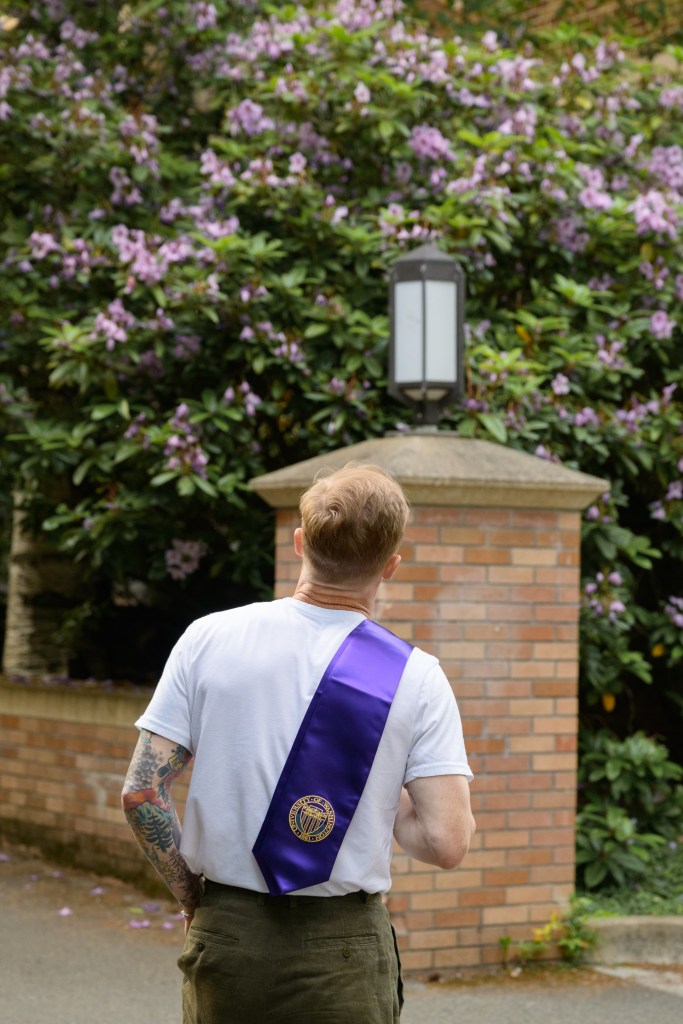
When I transferred to the University of Washington in 2023, after three years of community college and working full-time, I attended a day of advising and orientation lectures as part of the university entrance process. During one of these sessions, our advisor passed around a sheet of paper entitled “Academic Action Plan,” which was designed to help us better formulate our educational path. There were three columns on the paper titled Values, Interests, and Goals, which we would fill with our interpretations. Under Goals, I wrote: “Better understand the world around me and the systems it operates upon so I can change them.” Out of all the incoming students around me, I was the only one who articulated this desire to wield their education for change.
Perhaps there is no such thing as a “decent” education, and this was a failure on both Tara Westover’s and my part in trying to understand why we did not receive one. There are educational systems that prepare one to uphold the status quo, challenge it, or find a balance between the two. However, I believe an education should always be inquiry- and curiosity-led. It should give a few sides to any story rather than just one of them. As long as there is greed and the people we elect are supported by the wealthy, education will remain largely domesticating, preparing minds to enter the market as commodities. The homeschooling movement is still growing, and there are many children out there who, like me, have no say in their education or any legal protections from neglect, isolation, or emotional and spiritual abuse. The material conditions that undergird the conservative Christian homeschooling movement may not be so easily changed because those conditions largely stem from our economic model and secular marketplace. Still, I believe we can move toward a more equitable system. If we listen to understand, deeply reflect on history and the stories of those around us, and use that information to enact change, then we will bring about a more just world. Perhaps if we truly became our “brother’s keeper,” working always to ensure the well-being of our fellow citizens, anything could be possible (Gen. 4:9).
Works Cited
“ACLU History: The Scopes ‘Monkey Trial’.” ACLU, 1 Sept. 2010, www.aclu.org/documents/aclu-history-scopes-monkey-trial#:~:text=Americans%2C%20for%20the%20most%20part%2C%20viewed%20the,laws%20became%20the%20laughingstock%20of%20the%20country. Accessed 3 Jun. 2025.
Bruno-Jofré, Rosa del Carmen, et al., editors. Rethinking Freire and Illich : Historical, Philosophical, and Theological Perspectives. University of Toronto Press, 2023.
Chomsky, Noam. “Education: For Whom and For What?” Singju Post, 7 Mar. 2023, singjupost.com/education-for-whom-and-for-what-noam-chomsky-transcript/. Accessed 3 Jun. 2025.
“Federal Role in Education.” Department of Education, 1 May 2025, www.ed.gov/about/ed-overview/federal-role-in-education#:~:text=Despite%20the%20growth%20of%20the,excellence%20and%20ensuring%20equal%20access. Accessed 3 Jun. 2025.
Freire, Paulo, and Myra Bergman Ramos. Pedagogy of the Oppressed. 30th anniversary edition., Bloomsbury, 2014.
Green, Crystal. Freire and Critical Theorists. Bloomsbury Academic, 2023.
“History, Mission & Purpose.” Abeka, 1 Oct. 2025, www.abeka.com/AbekaDifference.aspx.
“Homeschooling: Last Week Tonight with John Oliver (HBO).” YouTube, uploaded by Last Week Tonight, 8 Oct. 2023, www.youtube.com/watch?v=lzsZP9o7SlI.
Ingersoll, Julie. Building God’s Kingdom : Inside the World of Christian Reconstruction. Oxford University Press, 2015. https://orbiscascade-washington.primo.exlibrisgroup.com/permalink/01ALLIANCE_UW/1juclfo/alma99161863060201452
Kunzman, Robert. “Homeschooling and Religious Fundamentalism.” International Electronic Journal of Elementary Education, vol. 3, no. 1, 2010, pp. 17–28. https://orbiscascade-washington.primo.exlibrisgroup.com/permalink/01ALLIANCE_UW/db578v/cdi_doaj_primary_oai_doaj_org_article_0c218c1b80d44c769fdf9a71fe37e059
Kunzman, Robert. Write These Laws on Your Children: Inside the World of Conservative Christian Homeschooling. 1st ed., Beacon Press, 2009. https://orbiscascade-washington.primo.exlibrisgroup.com/permalink/01ALLIANCE_UW/db578v/cdi_proquest_ebookcentral_EBC3118059
Melamed, Jodi. “Racial Capitalism.” Critical Ethnic Studies, vol. 1, no. 1, 2015, pp. 76–85, https://doi.org/10.5749/jcritethnstud.1.1.0076.
Stevens, Mitchell. Kingdom of Children: Culture and Controversy in the Homeschooling Movement. Core Textbook ed. Princeton University Press, 2009. Project MUSE, https://muse.jhu.edu/book/29759.
The Bible. King James Version Standard, King James Bible Online, 1769. https://www.kingjamesbibleonline.org/
“The Complete Works of Ralph Waldo Emerson: Essays. 2d series [Vol. 3].” In the digital collection The Complete Works of Ralph Waldo Emerson. https://name.umdl.umich.edu/4957107.0003.001. University of Michigan Library Digital Collections. Accessed June 3, 2025.
Wellman, Kathleen. Hijacking History: How the Christian Right Teaches History and Why It Matters. 1st ed., Oxford University Press, 2021, https://doi.org/10.1093/oso/9780197579237.001.0001.
Westover, Tara. Educated: A Memoir. Random House, 2018.
Works Consulted
Coalition for Responsible Home Education (n.d.). How to Pursue Healing and Justice as a Homeschool Alumni. Responsiblehomeschooling.org. Retrieved April 17, 2025, from https://responsiblehomeschooling.org/guides/a-message-for-homeschool-alumni/pursue-healing-and-justice/
Gibson, D. (2023, January 29). ‘She knows me least’ — 5 years after ‘Educated,’ Tara Westover’s family yearns for reconciliation. Is it possible? Deseret News. https://www.deseret.com/indepth/2023/1/29/23575258/what-does-educated-tara-westover-family-think-about-reconciliation-book/
Hamlin, D., & Cheng, A. (2022). Homeschooling, Perceived Social Isolation, and Life Trajectories: An Analysis of Formerly Homeschooled Adults. Journal of School Choice, 16(2), 332–359. https://doi-org.offcampus.lib.washington.edu/10.1080/15582159.2022.2028338
Johansen, Emily. “Making Sense of the Rural White Working Class: The Contemporary Novel of Rural Retreat and the Politics of Resentment.” Textual Practice, vol. 37, no. 4, 2023, pp. 642–61, https://doi.org/10.1080/0950236X.2022.2056764.
Kunzman, Robert. Write These Laws on Your Children: Inside the World of Conservative Christian Homeschooling. 1st ed., Beacon Press, 2009. https://orbiscascade-washington.primo.exlibrisgroup.com/permalink/01ALLIANCE_UW/db578v/cdi_proquest_ebookcentral_EBC3118059
Myers, Martin. “The Unhomely of Homeschooling.” Sociology (Oxford), vol. 57, no. 5, 2023, pp. 1101–17, https://doi.org/10.1177/00380385221129943.
“Noam Chomsky: Education For Whom and For What.” YouTube, uploaded by Collegeofsbs, 21 Feb. 2021, www.youtube.com/watch?v=2p9aKa08cRI&t=34s.
Stollar, R.L. “A Survival Guide for Homeschool Alumni.” Rlstollar.Com, 13 Jun. 2023, rlstollar.com/2023/06/13/a-survival-guide-for-homeschool-alumni/. Accessed 17 Apr. 2025.
“The Secret Power of Homeschoolers.” YouTube, uploaded by VICE News, 12 Oct. 2022, www.youtube.com/watch?v=9kuNycfklN4.
Warner Bros. Pictures, et al. Superman. Expanded ed., Warner Home Video, 2001.
 Sunday Coffee by Adam Ramer
Leave a comment